


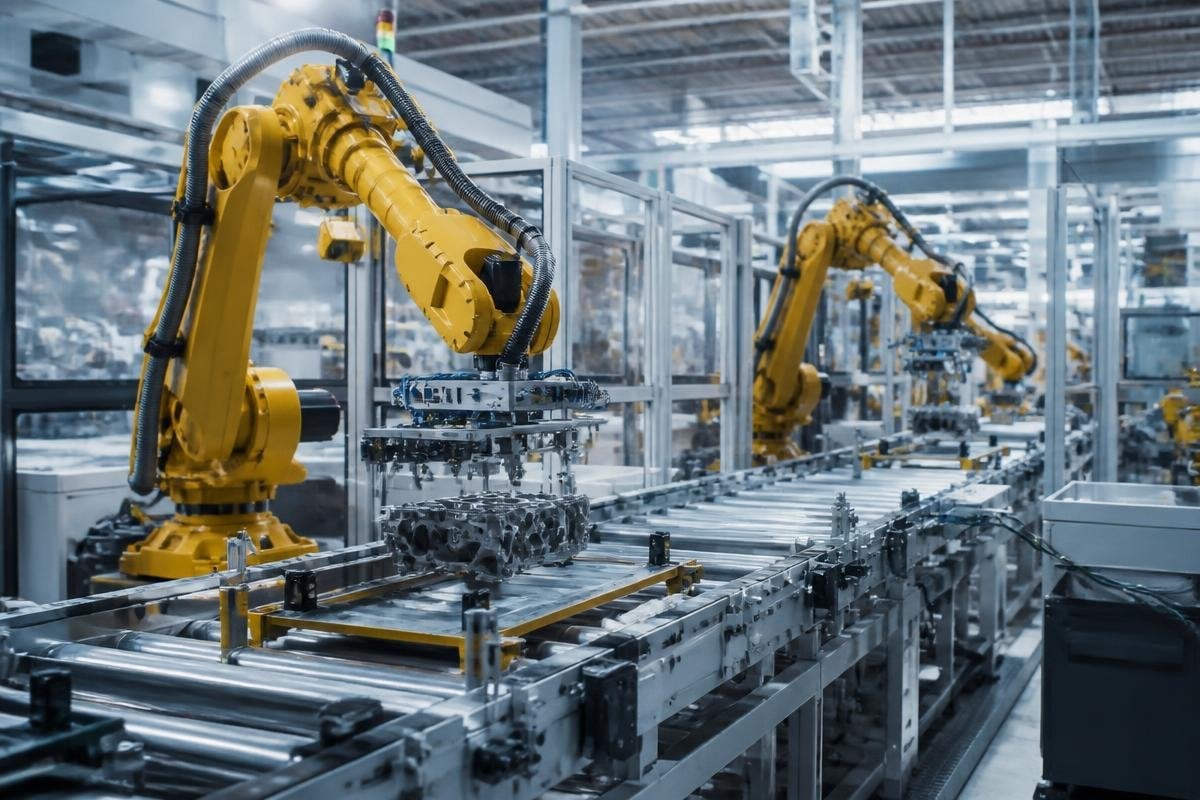
A smart factory does more than collect data from machines. It connects sensors, software, robots, and people so production can respond to changes on the floor. The next step is a factory where robots do more of the making, checking, moving, and machine care.
Quick read
- Robots can share production data with the systems that control a factory.
- Vision cameras and torque sensors give machines feedback about their work.
- The hardest part is often the space around the robot, not the robot itself.
From automated cells to connected work
A traditional automated cell repeats a set motion. A connected cell can also report its speed, motor temperature, fault codes, and job status. That information gives the production team a clearer view of what happened before a stop.
The control layer usually includes a programmable logic controller, or PLC. A PLC reads signals from equipment and sends commands back. It can tell a conveyor to stop, ask a robot to wait, or confirm that a part reached the next station.
That link changes the job of the robot. The arm still moves a part, but its work can now fit into a larger sequence. A camera may check the part before the arm picks it up. A sensor may confirm that the gripper has closed.
The production system can then record the result and send the part onward.
Robots need feedback
A robot factory depends on feedback because production parts are rarely identical in position. A vision camera can locate a part in a tray. A force or torque sensor can show whether a tool met the expected resistance. A LiDAR sensor can help a mobile robot detect people, walls, and equipment in its path.
Those sensors don’t make a robot independent of its surroundings. They give its software more information before it moves. The software still needs rules for speed, stopping, safe distances, and failed picks.
This is where the idea of a smart factory meets ordinary engineering work. Someone still has to set the robot’s coordinate frames, check the safety zones, tune the gripper, and decide what happens when a sensor gives an unclear reading.
Those settings decide whether a factory robot can repeat a job safely after the planned steps end. Reports from Robot 24 can tie a company’s claim to the machine, task, and factory test behind it, giving you a firmer basis for judging what the system can make.
The factory can make more than products
A robot factory can also produce information about its own work. A production system may record cycle time, rejected parts, tool changes, and stops. That record can help a technician find a worn gripper or a conveyor that is arriving late.
The useful result is a shorter path from fault to repair. A technician sees which station stopped, what signal came first, and whether the same fault appeared earlier. That does not remove the need for inspection, but it gives the inspection a better starting point.
The same data can support changes to production. A team may move a robot to a different task, change the order of two operations, or give a person the step that needs fine judgment. Shared formats make the factory easier to change when its machines describe their own state.
Where the idea runs into limits
Connection alone doesn’t fix a poor process. A robot can repeat a badly designed task with great consistency. A camera can also fail when lighting changes, a part is scratched, or another object blocks the view.
Safety adds another layer. A robot arm needs limits for reach and speed. A mobile robot needs a clear response when a person steps into its path. Equipment also needs a way to stop and restart without creating a new hazard.
The unproven part is how well each system handles change. A cell built for one part may need new tooling, new software rules, and new checks when the part changes. That work can cost more than the robot itself.
I’d judge a smart factory by how it handles a failed job, not by how smoothly the first demo runs.
A practical check before adding robots
Use these points before you approve a new robot cell:
- Name the task: record the part, tool, motion, cycle time, and handoff.
- Mark the exceptions: list damaged parts, missed picks, sensor faults, and human entry.
- Check the data path: confirm which system reads each signal and who sees the fault.
- Test the restart: stop the cell, clear the fault, and return it to work safely.
- Price the change: include tooling, guarding, software work, training, and maintenance.
A factory becomes a robot factory when its machines can share work, status, and fault information across the production line. The next useful measure is not how many robots arrive, but how many changes the line can handle without a long stop.
